Dichotomous Survey Questions: 25 Yes/No Examples and When They Mislead
What a dichotomous survey question is, 25 yes/no questions you can copy by situation, and the five cases where two answers hide the real one.
Dichotomous survey questions give people exactly two answers: yes or no, true or false, agree or disagree. They are the fastest question you can ask, and they are easy to count. They are also easy to get wrong. In one Pew Research Center test, 68% favored military action when asked a short favor-or-oppose question. When the question also named the cost in lives, support fell to 43%. Below is a plain definition, 25 dichotomous survey questions you can copy by situation, and the cases where two answers hide the real one.
What is a dichotomous survey question?
A dichotomous question is a closed question with two answer options that cover every case and do not overlap. "Dichotomous" means "cut in two". The common pairs are:
- Yes / No: "Did you finish the reading?"
- True / False: "The store opens at 9 on Sundays."
- Agree / Disagree: "The meeting was a good use of my time."
- Two named choices: "Online or in person?"
They work best for facts, past actions and simple decisions. One tap, no reading of a list, and the result is a single number: the share who said yes. That makes them a good fit for a live poll on a phone, a QR code on a table, or a quick check in class.
25 dichotomous survey questions examples by situation
Each of these dichotomous survey questions can run as a yes/no poll as it is. The right-hand column says when to add a third option or switch to multiple choice.
In the classroom
| # | Question | Watch for |
|---|---|---|
| 1 | Did you finish the reading before class? | Make it anonymous or few admit "No" |
| 2 | Did today's example make sense? | "Mostly" hides here; try a smiley scale |
| 3 | Do you want a review session before the test? | Fine as is |
| 4 | Should we move the quiz to Thursday? | Offer two days instead if both are open |
| 5 | Do you know when the project is due? | Fine as is |
In a team
| # | Question | Watch for |
|---|---|---|
| 6 | Can you join the Monday stand-up? | Fine as is |
| 7 | Should we keep the Friday demo? | "Yes, but shorter" needs a third option |
| 8 | Did you get what you needed from this meeting? | Fine as is |
| 9 | Do you have room for a new task this week? | Fine as is |
| 10 | Should we try written updates for two weeks? | Name the trial end, or "No" means "never" |
For events
| # | Question | Watch for |
|---|---|---|
| 11 | Will you come to the holiday party? | Add "Not sure yet" for an early RSVP |
| 12 | Do you need a vegetarian meal? | Fine as is |
| 13 | Is this your first event with us? | Fine as is |
| 14 | Should the next meetup be online? | "No" does not say which city or day |
| 15 | Would you come back next year? | People say yes kindly; read it as a ceiling |
For a local business
| # | Question | Watch for |
|---|---|---|
| 16 | Was your table ready when you arrived? | Fine as is |
| 17 | Did your appointment start on time? | Fine as is |
| 18 | Is this your first visit? | Fine as is |
| 19 | Would you like a text reminder before your next visit? | Fine as is |
| 20 | Were you happy with your visit? | Too broad; use a rating scale |
For creators and communities
| # | Question | Watch for |
|---|---|---|
| 21 | Do you want a part two? | Fine as is |
| 22 | Have you tried the recipe yet? | Fine as is |
| 23 | Should I post on weekends too? | Fine as is |
| 24 | Should we add a weekly Q&A? | Ask the day in a second poll |
| 25 | Did you watch the live stream? | Fine as is |
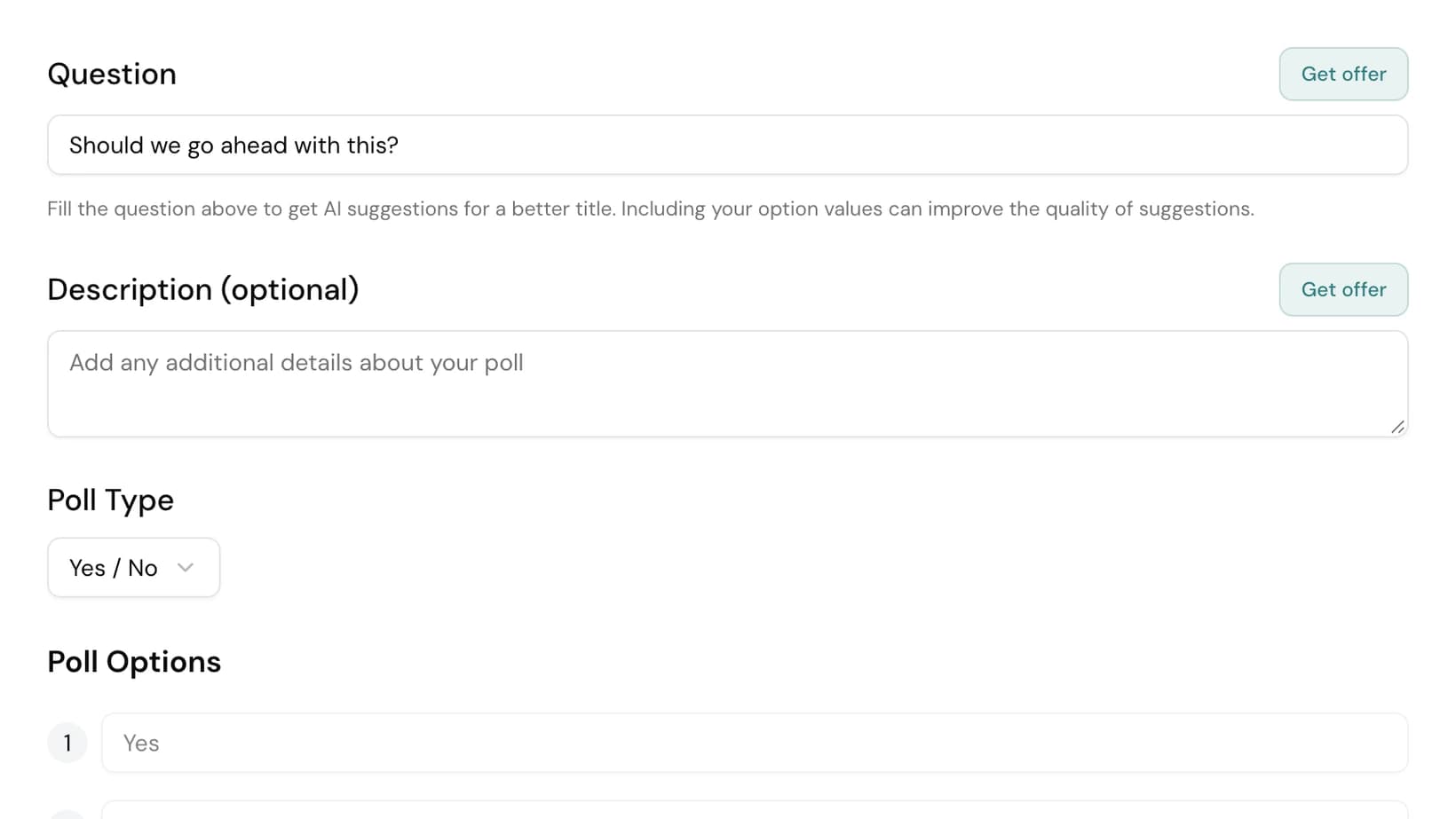
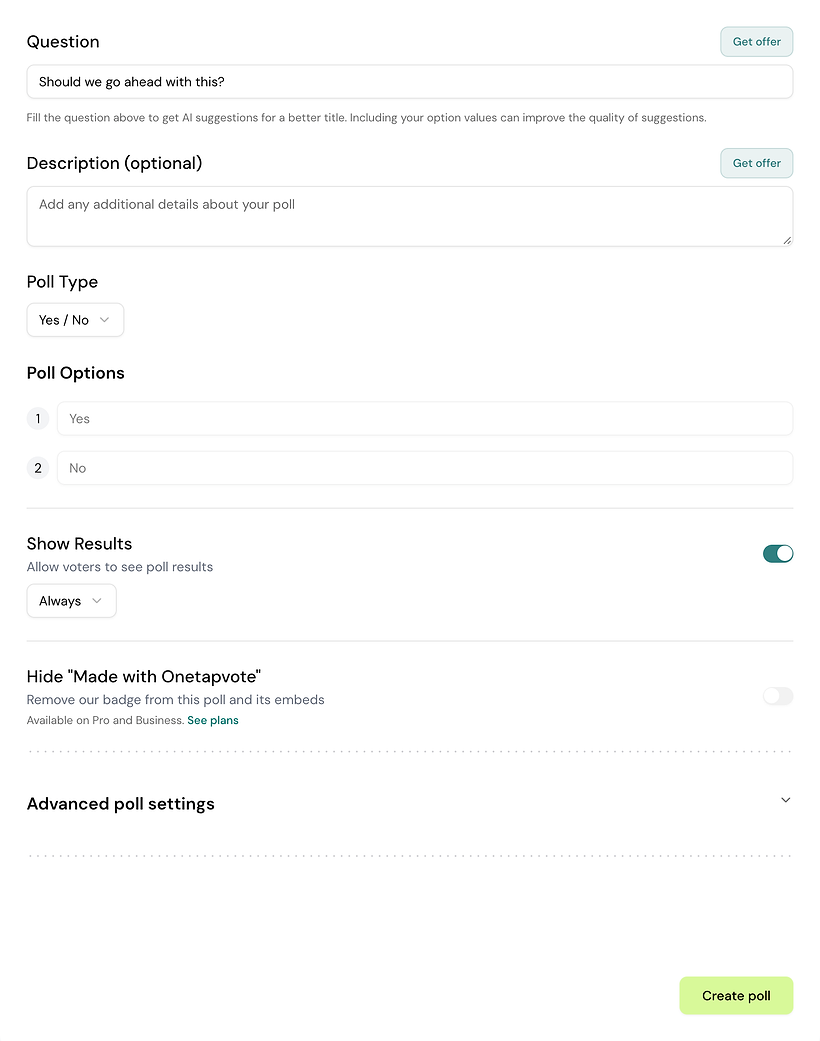
Run one as a live poll. Open the yes/no poll template, paste a question from the tables over the sample text, and press Create poll. Voters need no account. Share the link or a QR code and watch the results come in live.
When dichotomous survey questions mislead
Two answers are only honest when the truth has two sides. Dichotomous survey questions go wrong in five common ways. Here they are, with what to ask instead.
1. The real answer is a scale
"Were you happy with your visit?" A guest who was mostly happy picks "Yes", and you learn nothing about the slow check-in. Feelings and quality come in degrees. Use a 1–5 rating or a smiley face scale for those.
2. There are more than two real answers
"Should we order pizza?" A "No" tells you what people do not want, not what they do. When there are three or four real options, list them in a multiple choice poll. The same goes for days, places and names.
3. The wording does the voting
The Pew example from the top is worth a closer look. Same topic, same two sides. The only change was one clause about cost.
Support went from 68% to 43%, and the majority flipped to "oppose". A yes/no result is only as neutral as the sentence in front of it. Keep the question short, plain and free of loaded words, or show both sides in it.
4. Agree/disagree pulls toward "agree"
Pew notes that some people agree with almost any statement put to them. This is called acquiescence bias, and it is stronger when someone asks in person. Pew's advice is to offer "a choice between alternative statements" instead. So rather than "Our hours suit you: agree or disagree?", ask "Which suits you better: mornings or evenings?"
5. Two questions hide in one
"Was the food hot and fast?" If it was hot but slow, there is no right answer. Split it into two polls. Our guide on how to write a good poll question has more fixes like this.
Where yes/no beats a longer list
Dichotomous survey questions are not the weak option. Pew ran a test in 2018 with 4,581 U.S. adults. Half saw one "select all that apply" list. The other half answered a separate yes/no question for each item.
The yes/no group reported more of the events. On average, the share was 8 percentage points higher. Pew treats the higher numbers as the more accurate ones, because people tend to under-report these events. The lesson: if you want to know which of six things apply, ask six short yes/no questions, not one long checklist.
What OneTapVote does not do yet
The yes/no poll type always uses the labels "Yes" and "No". For true/false, agree/disagree or two named choices, pick Multiple choice and type your two options. You also cannot yet pass your own question in the link: the template opens with a sample question that you replace. Free accounts have limits on active polls and options; the pricing page lists them.
FAQ
What is an example of a dichotomous question?
"Did you finish the reading before class?" It has two answers, yes or no, and every student fits one of them.
Is "Not sure" allowed in a dichotomous question?
Strictly, no: a third option makes it a multiple choice question. Add it anyway when many people honestly do not know yet, such as an early RSVP.
Are true/false and agree/disagree questions dichotomous?
Yes. Any question with two answers that do not overlap is dichotomous. Agree/disagree needs extra care because of acquiescence bias.
How do I analyze dichotomous survey questions?
Count the share who said yes. With a few hundred answers or more, compare groups, such as first-time and returning visitors, by that share.
Pick one question from the tables and create a free yes/no poll; it takes about a minute.
Sources
Related tools & templates
- Free poll makerCreate a one-tap poll with a link and QR code. No sign-up for you or your voters.
- Customer satisfaction templateA ready-made CSAT question to share by link or QR code.
- NPS calculatorWork out your Net Promoter Score from totals or raw 0–10 answers.
- CSAT vs NPS vs CESWhich customer metric fits which question.
- Feedback FlowsEmail every customer a one-tap rating after the visit.
Thomas
Thomas is a digital technology enthusiast with a focus on data privacy, compliance, and online business trends.