Multiple Choice Survey Questions: 40 Examples You Can Copy
40 multiple choice questions for class, teams, events and customers, each with 3 or 4 answers written and a link to open it as a poll.
A multiple choice survey question gives people a fixed list of answers and asks them to pick one. Pew Research Center advises keeping that list small: "just four or perhaps five at most". So these multiple choice survey questions examples stop at 3 or 4 answers. There are 40 below, for class, teams, events and customers. Each one has its answers written, plus a link that opens it as a poll.
What makes a multiple choice question work
A good question asks one thing and offers answers that fit the people you are asking. Four checks catch most problems:
- One idea per question. "Was the food good and the service fast?" is really two questions. Pew calls this double-barreled and advises asking them separately.
- Answers do not overlap. "1 to 2 hours" and "2 to 3 hours" both fit someone who took 2 hours. Use "Under 2 hours" and "2 hours or more".
- Everyone has an answer. If some people will not fit, add a way out such as "None of these" or "Nothing right now".
- The order makes sense. Times and sizes run low to high. On a screen, people pay more attention to the top of a list, so do not always put your favorite first.
Need only two answers? See our yes/no question examples. Measuring how people feel? Smiley face rating scales fit better.
40 multiple choice survey questions examples
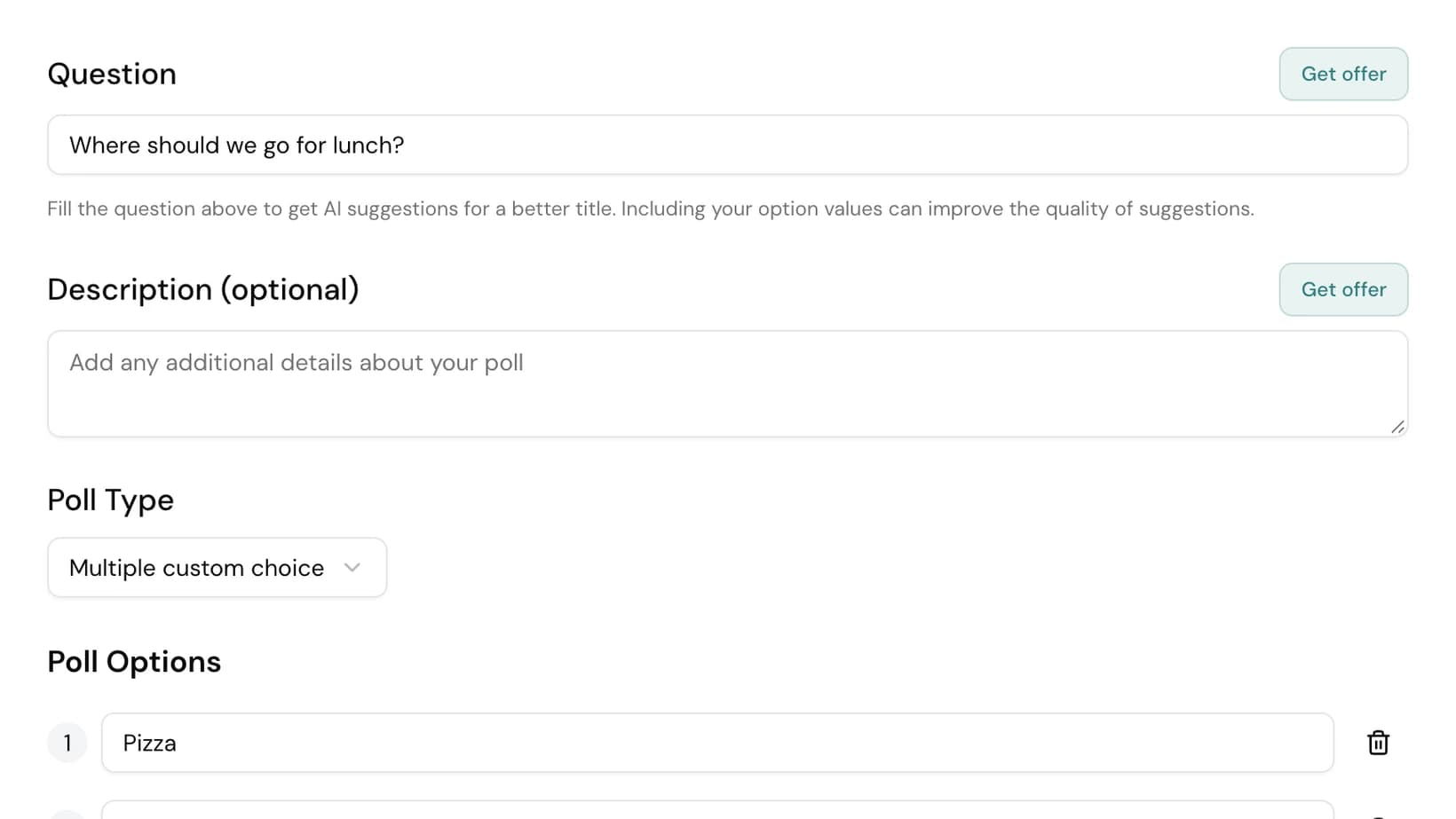
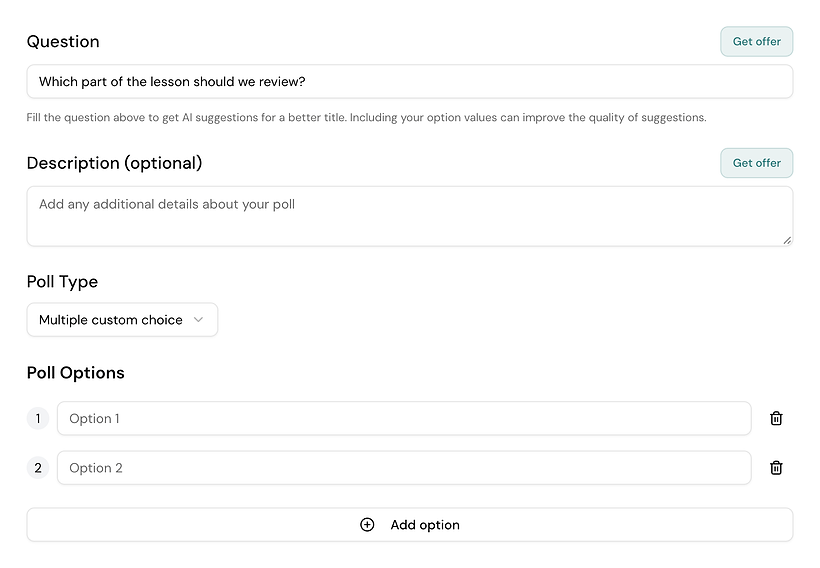
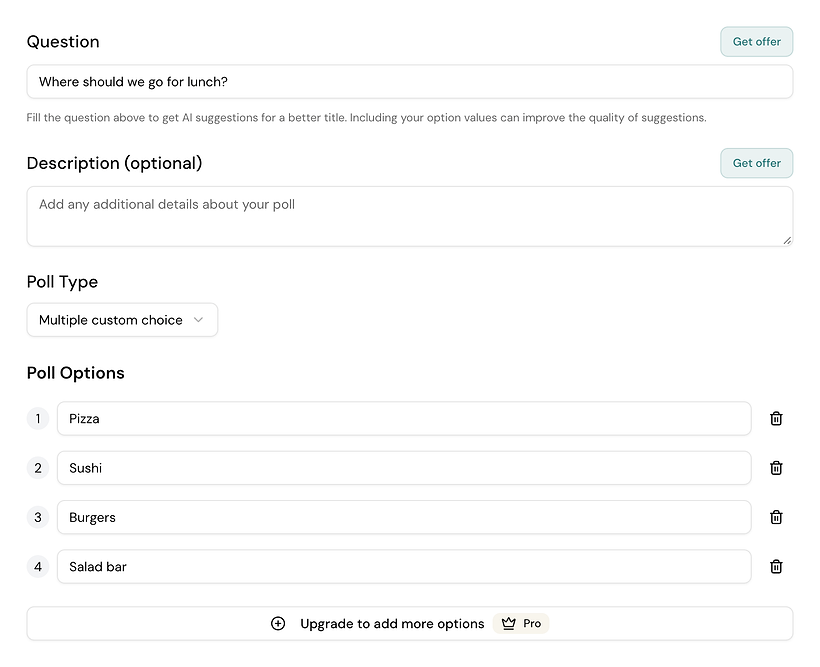
All of these multiple choice survey questions examples are free to copy and change. Open poll takes you to the poll form with the question filled in, and you type the answers. The 5 rows marked Open template fill in the answers too.
In the classroom
| # | Question | Answer options | Try it |
|---|---|---|---|
| 1 | Which part of the lesson should we review? | The vocabulary / The worked examples / The homework | Open poll |
| 2 | How sure are you about today's topic? | I could teach it / I mostly get it / I'm lost | Open poll |
| 3 | What should we do with the last 10 minutes? | Start the homework / Review for the quiz / Play a review game | Open poll |
| 4 | How did you study for this test? | Re-read my notes / Did practice problems / Studied with a friend / Did not study | Open poll |
| 5 | Which format do you want for the project? | Slides / Short video / Written report | Open poll |
| 6 | When should we hold the review session? | Before school / At lunch / After school | Open poll |
| 7 | What made the homework hard? | The instructions / The content / Not enough time / It wasn't hard | Open poll |
| 8 | Which topic should we read about next? | Space / Oceans / Ancient Egypt | Open poll |
| 9 | How long did the reading take you? | Under 15 minutes / 15 to 30 minutes / Over 30 minutes | Open poll |
| 10 | How do you want to work on Friday? | Alone / In pairs / In small groups | Open poll |
In a team
| # | Question | Answer options | Try it |
|---|---|---|---|
| 11 | Where should we go for lunch? | Pizza / Sushi / Burgers / Salad bar | Open template |
| 12 | When works best for our next meeting? | Monday 10:00 / Tuesday 14:00 / Wednesday 09:00 / Thursday 16:00 | Open template |
| 13 | Which feature should we build next? | Dark mode / Mobile app / Integrations / Better search | Open template |
| 14 | How should we run Friday's check-in? | On a call / In writing / Skip it this week | Open poll |
| 15 | What slows you down most this week? | Meetings / Waiting on others / Unclear priorities / Nothing right now | Open poll |
| 16 | How clear are this quarter's goals? | Very clear / Somewhat clear / Not clear | Open poll |
| 17 | Is our stand-up the right length? | Too short / About right / Too long | Open poll |
| 18 | Which day should be meeting-free? | Tuesday / Wednesday / Friday | Open poll |
| 19 | How do you want to get company news? | Email / Chat / Short all-hands | Open poll |
| 20 | What should the team outing be? | Bowling / Dinner / Escape room | Open poll |
At events
| # | Question | Answer options | Try it |
|---|---|---|---|
| 21 | Are you coming to the event? | Yes, I'll be there / Sorry, can't make it / Maybe — will confirm later | Open template |
| 22 | What topic should we cover next? | Getting started / Advanced tips / Behind the scenes / Q&A | Open template |
| 23 | Which meal would you like? | Chicken / Fish / Vegetarian | Open poll |
| 24 | How did you hear about this event? | A friend / Social media / Email / Somewhere else | Open poll |
| 25 | Which session did you like most? | Opening talk / Workshop / Panel | Open poll |
| 26 | How was the length of today's event? | Too short / About right / Too long | Open poll |
| 27 | What time should next year's event start? | 9 am / Noon / 5 pm | Open poll |
| 28 | What should we have for music? | Live band / DJ / Playlist | Open poll |
| 29 | How will you get here? | Drive / Public transit / Ride with someone | Open poll |
| 30 | What would bring you back next year? | Better speakers / More time to meet people / A lower ticket price / I'd come anyway | Open poll |
For customers (restaurants, salons, shops, gyms)
| # | Question | Answer options | Try it |
|---|---|---|---|
| 31 | How did you find us? | Google / A friend / Walked by / Social media | Open poll |
| 32 | What matters most when you choose where to eat? | The food / The price / The location | Open poll |
| 33 | How was your wait for a table? | No wait / Short wait / Too long | Open poll |
| 34 | What would you like more of on our menu? | Vegetarian dishes / Lunch specials / Kids' meals | Open poll |
| 35 | How often do you come here? | This is my first visit / A few times a year / Monthly or more | Open poll |
| 36 | What time suits you best for a salon appointment? | Morning / Afternoon / Evening | Open poll |
| 37 | How do you want to hear about offers? | Text / Email / Neither, thanks | Open poll |
| 38 | How do you usually book with us? | By phone / Online / I walk in | Open poll |
| 39 | What should we improve first? | Waiting time / Prices / Opening hours / Nothing comes to mind | Open poll |
| 40 | Which new class should our gym add? | Yoga / Spin / Boxing | Open poll |
Free plan limit. The free plan gives 3 answers per poll and Pro gives 10 answers. Of the 40 examples, 11 have 4 answers. Drop the weakest answer, or use the 7-day Pro trial, which needs no card. See pricing for the rest.
Why we stopped at 3 or 4 answers
Here is the honest part. We looked for a controlled test showing that a list of 4 answers gets more votes than a list of 8. We did not find one, so we will not quote a lift figure. This is what the research does say:
- Keep the list small. Pew gives its "four or perhaps five" advice with phone surveys most in mind, because people struggle to hold more choices in their heads.
- Long lists invite shortcuts. The research firm Kantar advises no more than 8 answers where possible and treats 15 as an upper limit. It warns that on long lists many people stop looking for the best answer and settle for one that will do.
- Long lists favor the top. Kantar also says that on longer lists, people are more likely to pick the answers that come first.
- "Choice overload" is weaker than its reputation. One review of 63 conditions from 50 experiments, with 5,036 people, found a mean effect of "virtually zero". Results varied a lot between studies.
So 3 or 4 is our judgment, not a law. A quick poll gets answered in a queue, at a table or with a teacher waiting. Three or four short answers can be read at a glance. A short results chart is also easier to read. There is more on this in our guide to short polls.
Go longer when the facts need it. Pew notes that a question on something like religious affiliation may need more categories, so that nobody is left out.
Your answer list shapes the result
A list does more than record opinions. It also suggests them. After the 2008 US election, Pew asked voters which issue mattered most, in two ways. With a list of five answers, 58% chose the economy. When people answered in their own words, 35% named it. And 43% of the open group gave an answer that the list had left out, against 8% of the group who saw the list.
If you do not know the likely answers yet, ask an open question first. Then build your list from what people actually say. For help with the wording, see how to write a good poll question.
What OneTapVote does not do yet
- One answer per vote. There is no "select all that apply". The "Allow multiple votes" setting lets someone vote again, not tick several boxes. If you need several picks, ask one question per item. Pew found that works better anyway: 19% reported being denied health insurance coverage when asked directly, against 13% on a checklist.
- No write-in answers. You can add an "Other" option, but voters cannot type what they mean by it.
- No shuffling. Answers stay in the order you typed them for every voter.
- Links fill in the question only. The 5 templates are the exception. For all other rows you type the answers yourself.
FAQ
How many answers should a multiple choice question have?
Three or four works for most quick polls. Pew advises four or perhaps five at most, especially on the phone. Use more only when the facts need it.
Should I add an "Other" option?
Add it when your list may miss real answers. Without a text box, "Other" only tells you that your list was incomplete, which is still useful.
Can people choose more than one answer?
In many survey tools, yes. OneTapVote polls take one answer per vote today. To measure several things, ask one question for each.
Is a rating scale a multiple choice question?
Strictly, yes: people pick from a fixed list. In practice a rating scale measures how much, and the examples here ask which one.
Pick one question from the tables and create a free poll; voters do not need an account.
Sources
- Pew Research Center: Writing Survey Questions
- Pew Research Center: When Online Survey Respondents Only 'Select Some That Apply' (2019)
- Kantar: 5 best practices for writing effective questionnaire response lists
- Scheibehenne, Greifeneder and Todd: Can There Ever Be Too Many Options? A Meta-Analytic Review of Choice Overload (2010)
Related tools & templates
- Free poll makerCreate a one-tap poll with a link and QR code. No sign-up for you or your voters.
- Customer satisfaction templateA ready-made CSAT question to share by link or QR code.
- NPS calculatorWork out your Net Promoter Score from totals or raw 0–10 answers.
- CSAT vs NPS vs CESWhich customer metric fits which question.
- Feedback FlowsEmail every customer a one-tap rating after the visit.
AI tools draft parts of our articles; a person reads and edits every one before it is published. Found a mistake? Write to [email protected]. How we write